


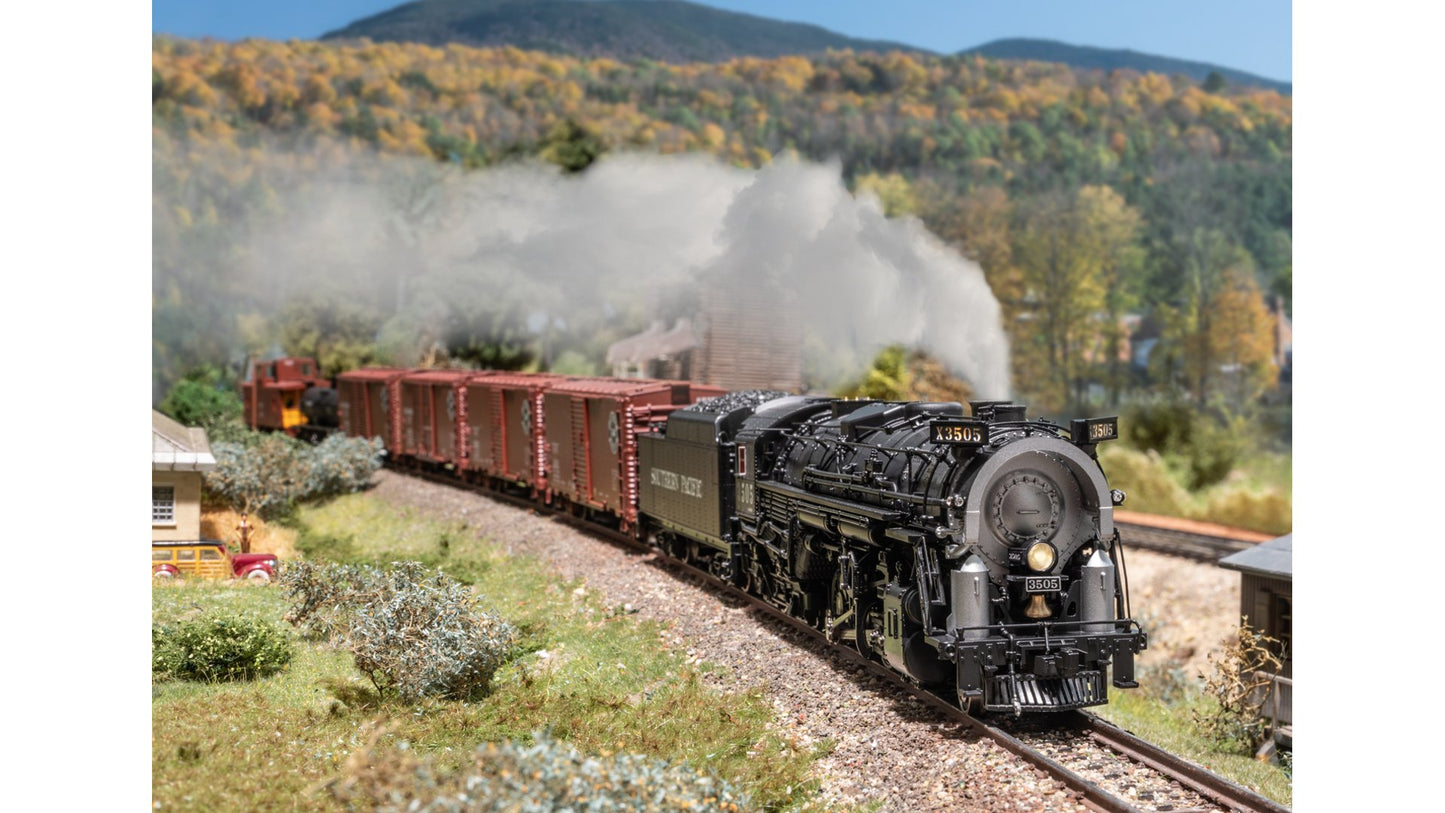
Märklin 37983 Berkshire 2-8-4 Steam Locomotive
Model: The unusual "Coffin Berkshires" Only a few steam locos in the USA went on to become legends like the “Big Boy” machines. However, the mighty “Berkshires” were certainly among them. They were products of the Roaring Twenties and symbolized the spirit of optimism that also took hold in the United States after the First World War. At a time when the economy was booming, and the railroads had to transport more and more goods faster and faster to all corners of the country, the thousands of “Mikado” steam locos built were often no longer capable of performing these tasks. This led to the birth of the first super-power steam locomotive in 1925. Developed by LIMA Locomotive Works, it had a two-axle trailing truck and an enlarged firebox and delivered a massive increase in performance to the railroad. And since these mighty locos were first used on a route through the Berkshire Mountains on the east coast of the USA, the members of this loco type were henceforth referred to as “Berkshires.” With an output of up to 4000 PS / 3945 hp and top speeds well in excess of 100 km/h / 62 mph, these machines, advertised by LIMA as super-power locomotives, conquered many US railroads with over 600 units built. The Boston & Maine Railroad also took delivery of 25 rather unusual-looking “Berkshires” that featured U-shaped Coffin feed-water heaters mounted upside down on the smokebox. Incidentally, the name “Coffin” refers to the manufacturer and has nothing to do with the literal meaning. Ten of these unusual “Berkshires” finished up their careers with the Southern Pacific Railroad in the years following 1945, although, sadly, none of these Coffin locos survived. Nevertheless, two of these giants can still be experienced in operation today. The Michigan-based “Berkshire,” road number 1225, even became an international movie star in 2004, when it played one of the starring roles in the animated children’s movie “The Polar Express,” which also captivated millions of viewers in Germany.
The locomotive has an mfx+ digital decoder and extensive light and sound functions. It also has a controlled high-performance motor with a flywheel, mounted in the boiler. Four axles are powered, three of them via coupling rods. Traction tires are fitted. The locomotive and tender are made mostly of metal. The factory-installed smoke generator with speed-dependent, dynamic smoke exhaust can be controlled digitally. The headlights, with one lamp on the loco and tender, change over with the direction of travel. They will work in conventional operation and can be controlled digitally. The cab lighting, number display lighting, and firebox flickering can be controlled separately in digital operation. Maintenance-free warm-white and red LEDs are used for the lighting. A buffer capacitor is fitted. There is an adjustable close coupler with a guide mechanism between the loco and tender. The tender has a close coupling with a guide mechanism and an NEM pocket. There are seated figures of a locomotive engineer and fireman in the cab. Piping for the area below the cab is included separately for installation on the locomotive. Length approx. 31.3 cm / 12-5/16".
Matching Southern Pacific freight cars are available in the Märklin H0 range as items 45667 and 45707 or in the Trix H0 range as item 24915 and include information about the necessary replacement wheel sets.
A DC version of this model is available in the Trix H0 range as item 25983.
Find more Märklin explanation videos on our YouTube Channel
Spare parts for our articles can be found here in our spare parts search.
Welcome to the second half of the 19th century, when the railroad was revolutionizing transportation in the United States of America at breathtaking speed and playing a central role in transforming the country into the land of opportunity. It was also a time of rapid development in steam locomotive construction. Driven by the mantra of creating ever bigger, more powerful, and faster designs, new loco types were often named after the areas in which they were used. The construction of a machine that had four driving axles as well as one leading and one trailing axle represented a milestone in freight traffic. As well as improving the performance on curves, the design permitted a longer boiler design compared to the locos without leading or trailing axles. A larger firebox also delivered an extra performance boost. Since the driving axles were now in front of the firebox, they could be made larger, which, in turn, enabled higher speeds. In 1897, the US company Baldwin delivered 20 of these machines to Japan and named the type “Mikado” in reference to a title honoring the Japanese emperor. As it happened, these locos were the most powerful Japanese steam locomotives of the period. This coincided with the start of the type's triumphant advance in the USA and subsequently in many other countries around the world. One of the most successful European “Mikados,” for example, was the German class 41 locomotive. In the USA, however, the “Mikados” soon reached their limits after the First World War. During the Roaring Twenties, the economy was booming, and the big railroad companies were competing for customers. They also needed to transport increasing volumes of freight faster and faster. In 1925, LIMA Locomotive Works responded by developing the basic “Mikado” design into the first super-power locomotive, which it also advertised as such. It boasted a much larger firebox, which massively increased the boiler output compared to the “Mikados.” To comply with the maximum axle loads, a two-axle truck was installed instead of a trailing axle. The prototype was intensively tested by the Boston & Albany Railroad (B&A), a subsidiary of the famous New York Central Railroad, on its main line that ran through the Berkshire Mountains on the east coast. The new loco demonstrated a substantial increase in performance compared to the older “Mikados.” The B&A was so impressed by this locomotive that it immediately placed an order for 25 units. Other railroad companies followed suit, and this type of locomotive soon became known as the “Berkshire.” In the end, over 600 “Berkshires” operated throughout the US, and production continued until 1949. Most of the “Berkshires” were based on the standard steam loco design with normal surface feed-water heaters that were mounted transversely on the smokebox. Conversely, the 25 “Berkshires” delivered to the Boston & Maine Railroad (B&M) in 1928/29 caused quite a stir with their unusual Coffin feed-water heaters, which were U-shaped and mounted upside down on the smokebox. As a result, people viewing the loco from the front often felt like they were staring into a dark cave. However, the name “Coffin” for the feed-water heater had nothing to do with its literal meaning and was simply the name of the manufacturer. In 1945, the B&M sold ten of these “Coffin Berkshires” to the Southern Pacific Railroad (SP) in the western USA, which was faced with a sudden increase in traffic. In keeping with the SP paint scheme for steam locos, the smokebox and the Coffin feed-water heater on these machines were painted silver, which significantly improved their appearance. Unfortunately, they only served with the SP for a few years, after which all the “Coffins” were scrapped. Despite this, numerous super-power “Berkshires” can still be admired in various museums today. Two of them are even still operational: Road number 765 of the former Nickel Plate Road and road number 1225, which LIMA built for the Pere Marquette Railroad in 1941, have been running for many years and bear witness to one of the most important chapters in US railroad history.







Highlights:
- Completely new tooling.
- Especially intricate metal construction.
- Many separately applied details.
- Factory-installed smoke generator with speed-dependent, dynamic smoke exhaust.
- The cab lighting can be controlled digitally.
- Seated figures of a locomotive engineer and fireman in the cab.
- World of Operation mfx+ decoder and extensive light and sound functions included.
- Buffer capacitor to bridge short unpowered sections of track.
Prototype: Southern Pacific “Berkshire” steam locomotive with the 2-8-4 wheel arrangement. Deep black basic paint scheme. Road number 3505. The loco looks as it did between 1945 and 1950. One of 25 locomotives built with the striking Coffin feed-water heater.
Digital Functions:
| Control Unit | Mobile Station | Mobile Station 2 | Central Station 1/2 | Central Station 3/2* Mobile Station 2** |
|
| Headlight(s) | • | • | • | • | • |
| Smoke generator | • | • | • | • | • |
| Steam locomotive op. sounds | • | • | • | • | • |
| Locomotive whistle | • | • | • | • | • |
| Direct control | • | • | • | • | • |
| Sound of squealing brakes off | • | • | • | • | |
| Number Board Lights | • | • | • | • | |
| Engineer’s cab lighting | • | • | • | • | |
| Bell | • | • | • | • | |
| Operating sounds | • | • | • | ||
| Letting off Steam | • | • | • | ||
| Air Pump | • | • | • | ||
| Water Pump | • | • | • | ||
| Injectors | • | • | • | ||
| Flickering Light in Fire Box | • | • | • | ||
| Switching maneuver | • | • | • | ||
| Whistle for switching maneuver | • | ||||
| Coupler sounds | • | ||||
| Coal being shoveled and firebox flickering | • | ||||
| Replenishing water | • | ||||
| Replenishing coal | • | ||||
| Replenishing sand | • | ||||
| Opening side cab window | • | ||||
| Operating sounds | • | ||||
| Dialog | • | ||||
| Sanding | • | ||||
| Generator Sounds | • | ||||
| Generator Sounds | • | ||||
| Safety Valve | • |
* New features of the Central Station 2 (Part No. 60213, 60214 or 60215) with the software update 4.2
** New features of the Mobile Station 2 (Part No. 60657/66955) with the Software Update 3.55
Specifications:
- Length over the buffers approximately 3.13 cm
- Scale: H0 (1:87)
- Type: Steam Locomotives
Warning
|
ATTENTION: not suitable for children under 15 years. This product contains small parts that may be a choking hazard. |