


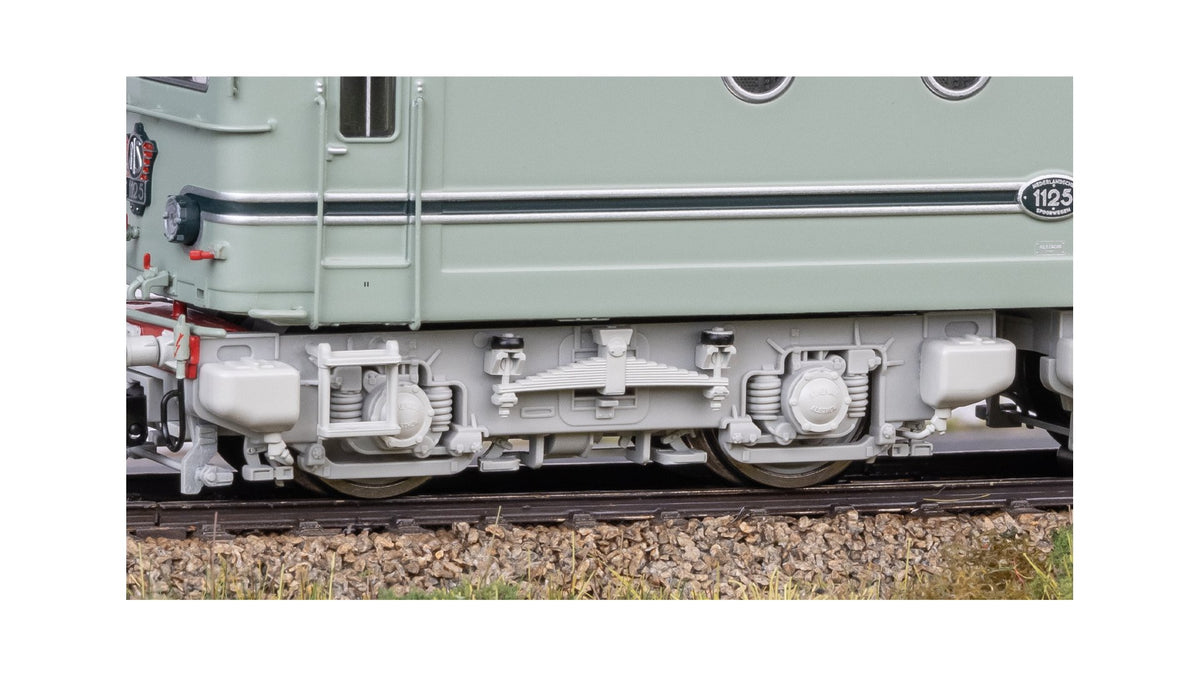
Märklin 38111 Class 1100 Electric Locomotive
Model: The year is 1950. There was a great spirit of optimism everywhere in the war-torn countries of Western Europe. The railroad also played a decisive role in this. At the time, it represented freedom and mobility – and also symbolized the dawn of a new era. Naturally, this also applied to the Netherlands, where numerous lines had already been electrified before the Second World War. For this reason, one priority of the “Nederlandse Spoorwegen” (NS) after 1945 was to rapidly expand electric operation and modernize the locomotive fleet. To secure modern locos quickly, the company turned to the French class BB 8100, which had been operating reliably in the neighboring country since 1947. With its two powered, two-axle trucks, this loco type was equipped with the very latest drive technology. In the end, NS ordered 60 machines from Alstom in Belfort and added them to its loco fleet as the class 1100. With an output of 2,722 hp and a top speed of 120 km/h / 75 mph, they soon dominated train haulage on electrified NS routes. They also hauled prominent trains such as the TEE “Rheingold” and “Rembrandt,” or the “Italy-Holland Express.” For four decades, the rugged class 1100 locos were indispensable traction units in the Netherlands, and the last unit was only withdrawn in 1999. Locomotive 1125 was restored to its original 1950s condition at great expense. It can now be admired as a unique treasure in the Railway Museum in Utrecht. Unfortunately, like the other five surviving units, this machine is not operational. However, the new and beautifully detailed Märklin model will make it possible to recreate trains such as the “Rheingold” hauled by a class 1100 in miniature in the future.
The loco has an mfx+ digital decoder and extensive light and sound functions. It also has a controlled, high-performance motor with a flywheel, centrally mounted. All four axles are powered by cardan shafts. Traction tires are fitted. Dual headlights and dual raised red marker lights change ends with the direction of travel, operate conventionally, and can be controlled digitally. The special L-signal function (2 x yellow below, 1 x white above) can also be controlled digitally. The headlights at no. 1 and no. 2 ends can be turned off separately in digital operation. When the headlights are off at both ends, the switching light at each end is 1 x yellow below. The cab and machine room lighting can each be controlled separately in digital operation. Maintenance-free yellow, warm white, and red LEDs are used for the lighting. A buffer capacitor is fitted. Detailed roof equipment with redesigned Faively G5 scissor pantographs. The truck is fitted with close couplers in an NEM pocket. The buffer height conforms to NEM specifications. Brake lines and screw couplers are included separately for installation on the model. Length over buffers 14.9 cm / 5-7/8".
A DC version of this model is available in the Trix H0 range as item 25111.
Find more Märklin explanation videos on our YouTube Channel
Spare parts for our articles can be found here in our spare parts search.







Highlights:
- New tooling with prototypical detail modifications.
- This is a version of the museum locomotive bearing loco number 1125 at the Railroad Museum in Utrecht.
- The loco is from the first production run, without end reinforcement (loco numbers 1101 to 1150).
- Intricate metal construction with many separately applied details.
- Cab and machine room lighting controlled digitally.
- Close couplers in NEM pockets.
- World of Operation mfx+ decoder with extensive light and sound functions.
- A buffer capacitor to bridge short unpowered sections of track is fitted.
- The buffer height conforms to NEM specifications.
Prototype: Dutch Railways (NS) class 1100 electric locomotive. The model replicates the prototype as it currently looks as a museum loco in the Railway Museum in Utrecht. The model is based on a loco from the first production run, without end reinforcement. The colors approximate its paint scheme from the 1950s when it entered service, with a turquoise body and agate gray running gear. With raised decorative strips. Trucks with rectangular recesses. Locomotive road number 1125. The model replicates the current museum condition of the prototype.
Digital Functions:
| Control Unit | Mobile Station | Mobile Station 2 | Central Station 1/2 | Central Station 3/2* Mobile Station 2** |
|
| Headlight(s) | • | • | • | • | • |
| Special light function | • | • | • | • | • |
| Electric locomotive op. sounds | • | • | • | • | • |
| High Pitch Horn | • | • | • | • | • |
| Direct control | • | • | • | • | • |
| Engine room lighting | • | • | • | • | |
| Engineer’s cab lighting | • | • | • | • | |
| Low Pitch Horn | • | • | • | • | |
| Engineer’s cab lighting | • | • | • | • | |
| Sound of squealing brakes off | • | • | • | ||
| Headlights locomotive end 2 off | • | • | • | ||
| Headlights locomotive end 1 off | • | • | • | ||
| Blower motors | • | • | • | ||
| Compressor | • | • | • | ||
| Letting off Air | • | • | • | ||
| Pantograph Sounds | • | • | • | ||
| Sanding | • | ||||
| Rail Joints | • | ||||
| Conductor's Whistle | • | ||||
| Sound of Couplers Engaging | • | ||||
| Switching range + switching light | • | ||||
| Buffer to buffer | • | ||||
| Announcement: history of the locomotive | • |
* New features of the Central Station 2 (Part No. 60213, 60214 or 60215) with the software update 4.2
** New features of the Mobile Station 2 (Part No. 60657/66955) with the Software Update 3.55
Specifications:
- Length over the buffers approximately 1.49 cm
- Scale: H0 (1:87)
- Type: Electric Locomotives
Warning
|
ATTENTION: not suitable for children under 15 years. This product contains small parts that may be a choking hazard. |