


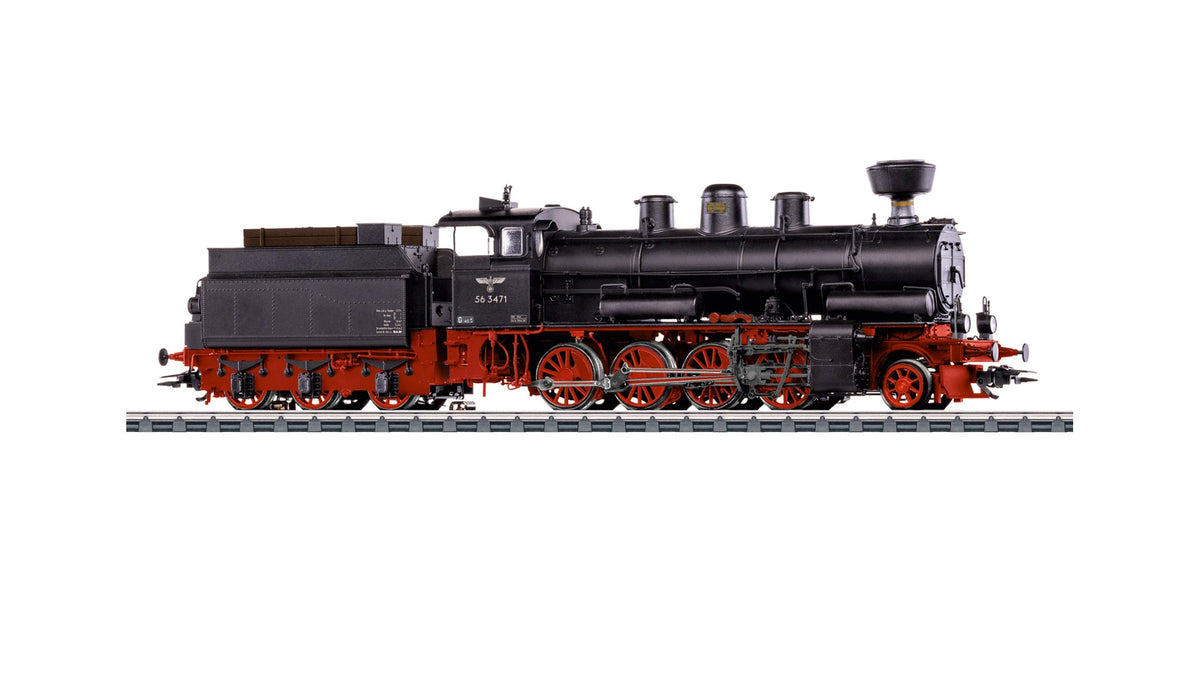
Märklin 38270 Class 56.34-35 Steam Locomotive
Model: A revolutionary design: The first European loco In 1897, a brilliant young engineer designed a steam loco for the Habsburg Monarchy that went on to become one of the most important workhorses on the rails in many European countries. At the time, Karl Gölsdorf was the chief design engineer at the Vienna locomotive division of the Imperial Royal Austrian State Railways (kkStB). He was commissioned to design a modern and powerful general-purpose locomotive for the Arlberg Railway that would be capable of hauling even express trains along the mountainous route with its steep gradients and sharp curves. The result was the class 170, an eight-coupled tender locomotive with a leading axle, which entered service as the most powerful steam loco in continental Europe with an output of nearly 1,000 hp. The more modern superheated steam variant, the class 270, was developed by Gölsdorf's successor, Mr. Johann Rihosek and built from 1917 onwards. In the end, well over 1,000 units of both classes of this robust and reliable general-purpose locomotive were in service on the railroads of many Central, Southern, and Eastern European countries. Following the annexation of Austria in 1938, as many as 100 locos were added to the German National Railway fleet as the class 56.34-35. Even after 1945, this masterpiece of Austrian steam locomotive engineering continued to provide valuable service across many regions, and the last units only disappeared from scheduled services in the mid-1970s. As a finely detailed European steam loco in 1:87 scale, the new Märklin model now pays fitting tribute to this jack-of-all-trades that is so highly prized by railroad enthusiasts.
The loco has an mfx+ digital decoder and extensive light and sound functions. It also has a controlled high-performance motor with a flywheel, mounted in the boiler. One axle is powered directly, and three axles are driven by coupling rods. Traction tires are fitted. The locomotive and tender are constructed mostly of metal. The loco has a factory-fitted smoke generator with speed-dependent, dynamic smoke exhaust. Dual headlights change over with the direction of travel, will work in conventional operation and can be controlled digitally. The cab lighting, firebox flickering, and running gear lights can be individually controlled in digital operation. Maintenance-free warm-white and red LEDs are used for the lighting. A buffer capacitor is fitted. There is a close coupler with a guide mechanism between the loco and tender. The buffer heights on the loco and tender conform to NEM specifications. The minimum radius for operation is 360 mm / 14-3/16". Protective piston sleeves and brake hoses are supplied. Length over the buffers approximately 20 cm / 7-7/8".
As a more powerful evolution of the widely used class 170 steam loco of the Imperial Royal Austrian State Railways, the class 270 superheated steam locomotive was introduced at the end of the First World War. The machines proved to be so capable that, after the war, additional orders were placed in Austria as well as in the states that succeeded the monarchy. The BBÖ ended up operating a total of 100 locomotives, which were then designated the class 56.34-35 following the annexation of Austria by Germany in 1938. During its service life with the DRB, the loco was used as a “jack-of-all-trades.”
A matching freight car set is also available in the Märklin H0 range as item 46570. This model has been developed in partnership with PIKO Spielwaren GmbH, Sonneberg, Germany.
Find more Märklin explanation videos on our YouTube Channel
Spare parts for our articles can be found here in our spare parts search.
It was one of the most famous mountain railroads in Europe that led to the construction of an extremely successful locomotive type. And it wasn’t an imposing, record-breaking express locomotive but rather an unassuming general-purpose genius on rails that was nonetheless considered a revolutionary design at the end of the 19th century. It was designed by the brilliant Austrian engineer Karl Gölsdorf, who was making a name for himself throughout Europe at the time by designing exceptionally advanced and powerful steam locomotives. In 1897, the Imperial Royal Austrian State Railways (kkStB) of the Habsburg Dual Monarchy commissioned their chief engineer to design a modern and powerful machine that would be versatile and able to haul even express trains along the winding, mountainous route of the Arlberg Railway with its steep gradients. The result was the class 170, an eight-coupled tender locomotive with a leading axle, which entered service as the most powerful steam loco in continental Europe with an output of nearly 1,000 hp. Another important milestone in locomotive engineering was the three Gölsdorf axles, which were used for the first time on the class 170 and named after their inventor. These had a certain degree of lateral play that significantly improved the locomotive’s performance on curves. This also dramatically reduced the amount of wear on the wheel flanges and rails, which was a major advantage on the many mountainous routes in the kkStB railroad network. The class 170 loco ultimately proved so successful that, by 1919, no less than 796 units had been put into service, making it the most prolifically built Austrian steam loco type. As a saturated steam locomotive, however, the 170 suffered from relatively high fuel consumption. Although the far more efficient superheated steam technology had dominated steam locomotive engineering as far back as 1905, the superheated steam version of the class 170 only entered service in 1917 as the class 270. That version delivered a further significant boost in performance. After all, it could now make 1,400 hp available at the draw hook. However, Austria, which had been badly affected by the First World War, only purchased 100 of these “Super-170” machines, while their predecessors continued to serve the country well. On the other hand, the states that succeeded the Habsburg Monarchy embraced Gölsdorf’s ingenious design with great enthusiasm. The Czechs had the class 270 loco built for their national railway up until 1930; Poland and Romania procured well over 100 machines each, and Italy put 25 brand-new class 270s into service. After Austria’s annexation, even the German State Railroad Company (DRG) benefited from this Austrian general-purpose loco. All 100 machines built for the Federal Railways / BBÖ were added to the German locomotive fleet in 1938 as road numbers 56 3401–3500. This meant that the revolutionary Gölsdorf design finally became a truly European locomotive that could still be admired in operation well into the 1970s, for example, in Czechoslovakia, Romania, Yugoslavia, and in its home country of Austria, where the last units were only decommissioned by the Graz-Köflach Railroad in 1975 – a full 78 years after Gölsdorf first put this design on the rails. This represents a truly remarkable success in European locomotive history.







Highlights:
- Completely new tooling.
- Detailed design made largely of metal.
- Motor in the locomotive.
- Finely detailed design with numerous separately applied parts. Prototypical and detailed implementation of all defining details on the loco, including the characteristic Kobel smokestack, the large Austrian lamps, as well as the classic kkStB cab.
- Factory-installed smoke generator and speed-dependent, dynamic smoke exhaust.
- Cab lighting, firebox flickering, and running gear lights can be controlled digitally.
- The buffer height conforms to NEM specifications.
- With buffer capacitor to bridge short unpowered sections of track.
Prototype: German National Railway (DRB) class 56.34-35 freight steam locomotive with a tender, former class 270 of the Imperial Royal Austrian State Railways (kkStB) and the Austrian Federal Railways (BBÖ). The loco looks as it did after the BBÖ was incorporated into the German National Railway starting in 1938.
Digital Functions:
| Control Unit | Mobile Station | Mobile Station 2 | Central Station 1/2 | Central Station 3/2* Mobile Station 2** |
|
| Headlight(s) | • | • | • | • | • |
| Smoke generator | • | • | • | • | • |
| Steam locomotive op. sounds | • | • | • | • | • |
| Locomotive whistle | • | • | • | • | • |
| Direct control | • | • | • | • | • |
| Engineer’s cab lighting | • | • | • | • | |
| Flickering Light in Fire Box | • | • | • | • | |
| Whistle for switching maneuver | • | • | • | • | |
| Running gear lights | • | • | • | • | |
| Letting off Steam | • | • | • | ||
| Sound of squealing brakes off | • | • | • | ||
| Tipping grate | • | • | • | ||
| Air Pump | • | • | • | ||
| Water Pump | • | • | • | ||
| Injectors | • | • | • | ||
| Sanding | • | • | • | ||
| Replenishing coal | • | ||||
| Replenishing water | • | ||||
| Replenishing sand | • | ||||
| "Switcher Double ""A"" Light" | • | ||||
| Switching range + switching light | • | ||||
| Generator Sounds | • | ||||
| Light Function | • | ||||
| Rail Joints | • | ||||
| Sound of Couplers Engaging | • | ||||
| Sound of uncoupling | • |
* New features of the Central Station 2 (Part No. 60213, 60214 or 60215) with the software update 4.2
** New features of the Mobile Station 2 (Part No. 60657/66955) with the Software Update 3.55
Specifications:
- Length over the buffers approximately 2.00 cm
- Scale: H0 (1:87)
- Type: Steam Locomotives
Warning
|
ATTENTION: not suitable for children under 15 years. This product contains small parts that may be a choking hazard. |