


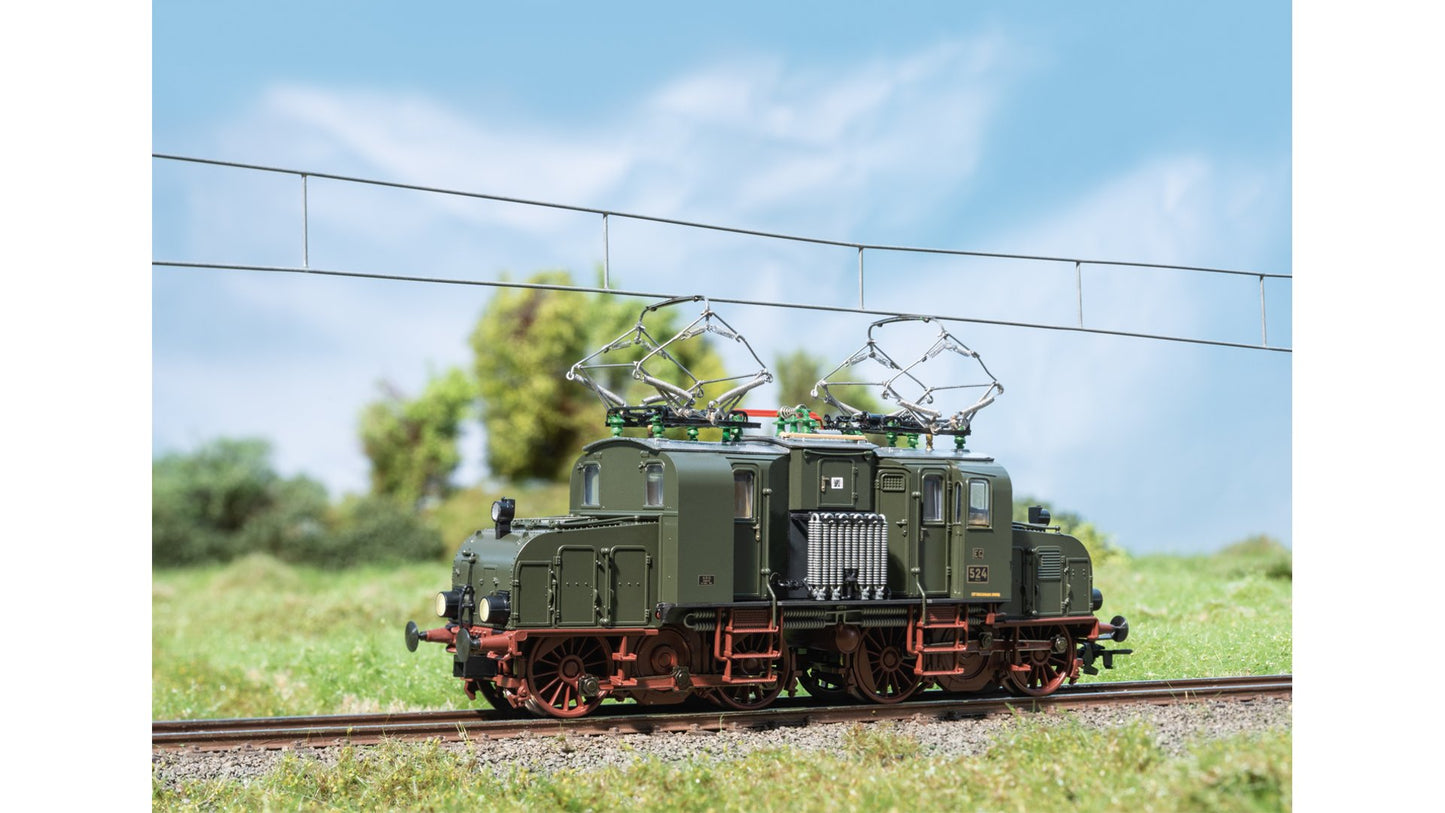
Märklin 39772 Class EG 524 Electric Locomotive
Model: The loco has an mfx+ digital decoder and extensive sound functions. It also has a controlled, high-performance motor with a flywheel, centrally mounted. Both axles in each truck are powered by cardan shafts. Traction tires are fitted. Dual headlights and dual red marker lights change ends with the direction of travel, will work in conventional operation, and can be controlled digitally. Headlights at no. 1 and no. 2 loco ends can be turned off separately in digital operation. The third headlight, which can function as an oncoming train light, and the cab lighting can be controlled digitally. Maintenance-free, warm-white, and red LEDs are used for the lighting. A buffer capacitor is fitted. The model had many separately applied parts, such as grab irons and brake hoses. Both powered trucks are connected to one another by coupling rods. The buffer height conforms to NEM specifications. A booklet about the history of the locomotive is included. Length over buffers 13.3 cm / 5-1/4".
Locomotive 1 of 6 in the dealer initiative collector’s series “History of Electric Locomotives from Era I-VI.”
A DC version of this model is available in the Trix H0 range as item 25772.
Find more Märklin explanation videos on our YouTube Channel
Spare parts for our articles can be found here in our spare parts search.
One-time series.
As early as 1906, the Prussian State Railroad decided to electrify the long-distance line Magdeburg – Dessau – Leipzig – Halle, and in 1911, the decision was taken to electrify the Silesian mountain railroad between Görlitz and the Waldenburg coalfields. In July of 1912, the railroad division in Halle ordered new electric locomotives for operation in larger production runs, among them 18 B-B coupled units for freight traffic as road numbers EG 511-528 (later the class E 71). A subsequent order of nine additional locomotives followed the next year (road numbers EG 529-537). Road numbers EG 511 and 512 were put into operation in the spring of 1914, and road number EG 513 did not follow until the summer of 1915. The outbreak of World War I delayed further construction of the units ordered, and AEG only delivered the rest, road numbers EG 514-537, between 1920 and 1921. The DRG designated only road numbers EG 511 and 513-537 as road numbers E 71 11 and 13-37 in the fall of 1926, since road number EG 512 had to be retired in the same year after a serious accident.
The class E 71 revealed a thoroughly modern design for the times: Its drive system was executed using two traction motors mounted at half height in each power truck, which were connected to the driving wheels using intermediate gears and slotted coupling rods. On top of the two close-coupled power trucks, the box-style body with its two cabs, as well as a rounded nose section at both ends, was supported using friction bearing plates and pivots. The motor voltage was regulated by electro-pneumatic contactors in eleven continuous speed levels. Starting in 1923, all of these locomotives were based in Halle, but the class E 71 units were soon no longer able to meet the requirements due to increasing train loads. The delivery of the new class E 75 starting in 1931 meant that the class E 71 units were no longer needed, except for a few units. By 1932, the latter found a new home at Basle (road numbers E 71 11, 13, 14, 17, 22, 23, 25, 26, 29, 31, 32, 33, and 35). There, they replaced the old Baden electric locomotives on the Wiesen and Wehratal Line and were quickly designated affectionately “Flat Irons” due to their appearance. These locomotives were equipped with improved traction motor cooling, electric train heating, as well as BBC safety running circuits to enable their use in Baden for passenger service, with the maximum speed increased to 65 km/h / 41 mph.
Between 1930 and 1946, road numbers E 71 11, 15-17, 20, 21, 23-25, 27, and 33-37 were retired. After the DB was founded in 1949, only nine units at Basle were still running (road numbers E 71 13, 14, 18, 19, 22, 26, 28, 29, and 32) on the Wiesen and Wehratal Line. Increasing difficulties in sourcing spare parts led to the replacement of these elderly units by the class E 32 starting in 1957. Road numbers E 71 14, 18, 19, 22, and 26 were put into storage on June 2, 1957. The last four units were retired between November 1957 and December 1958. These road numbers have been preserved: E 71 19 (DB Museum Koblenz), E 71 28 (German Museum of Technology in Berlin), and E 71 30 (Dresden Transport Museum).







Highlights:
- Extensive tooling changes to correctly implement a version from era I.
- Pantographs with completely new tooling.
- Especially intricate metal construction.
- The model has many separately applied details.
- The cab lighting can be controlled digitally.
- World of Operation mfx+ decoder with extensive operating and sound functions.
- The buffer height conforms to NEM specifications.
- A buffer capacitor to bridge short unpowered sections of track is fitted.
- A booklet about the history of the locomotive is included.
Prototype: German National Railway (DRB) electric locomotive, road number EG 524 HALLE (later the class E 71.1). Brownish green basic paint scheme. Road number EG 524. The loco looks as it did starting in 1921.
Digital Functions:
| Control Unit | Mobile Station | Mobile Station 2 | Central Station 1/2 | Central Station 3/2* Mobile Station 2** |
|
| Headlight(s) | • | • | • | • | • |
| Light(s) for Oncoming Train | • | • | • | • | • |
| Electric locomotive op. sounds | • | • | • | • | • |
| Locomotive whistle | • | • | • | • | • |
| Direct control | • | • | • | • | • |
| Sound of squealing brakes off | • | • | • | • | |
| Engineer’s cab lighting | • | • | • | • | |
| Headlights locomotive end 2 off | • | • | • | • | |
| Whistle for switching maneuver | • | • | • | • | |
| Switching range + switching light | • | • | • | ||
| Headlights locomotive end 1 off | • | • | • | ||
| Engineer’s cab lighting | • | • | • | ||
| Blower motors | • | • | • | ||
| Brake Compressor | • | • | • | ||
| Letting off Air | • | • | • | ||
| Coupler sounds | • | • | • | ||
| Opening cab door | • | ||||
| Pantograph Sounds | • | ||||
| Rail Joints | • | ||||
| Surrounding sounds | • | ||||
| Operating sounds | • | ||||
| Conductor's Whistle | • | ||||
| Sanding | • | ||||
| Announcement: history of the locomotive | • |
* New features of the Central Station 2 (Part No. 60213, 60214 or 60215) with the software update 4.2
** New features of the Mobile Station 2 (Part No. 60657/66955) with the Software Update 3.55
Specifications:
- Length over the buffers approximately 1.33 cm
- Scale: H0 (1:87)
- Type: Electric Locomotives
Warning
|
ATTENTION: not suitable for children under 15 years. This product contains small parts that may be a choking hazard. |