


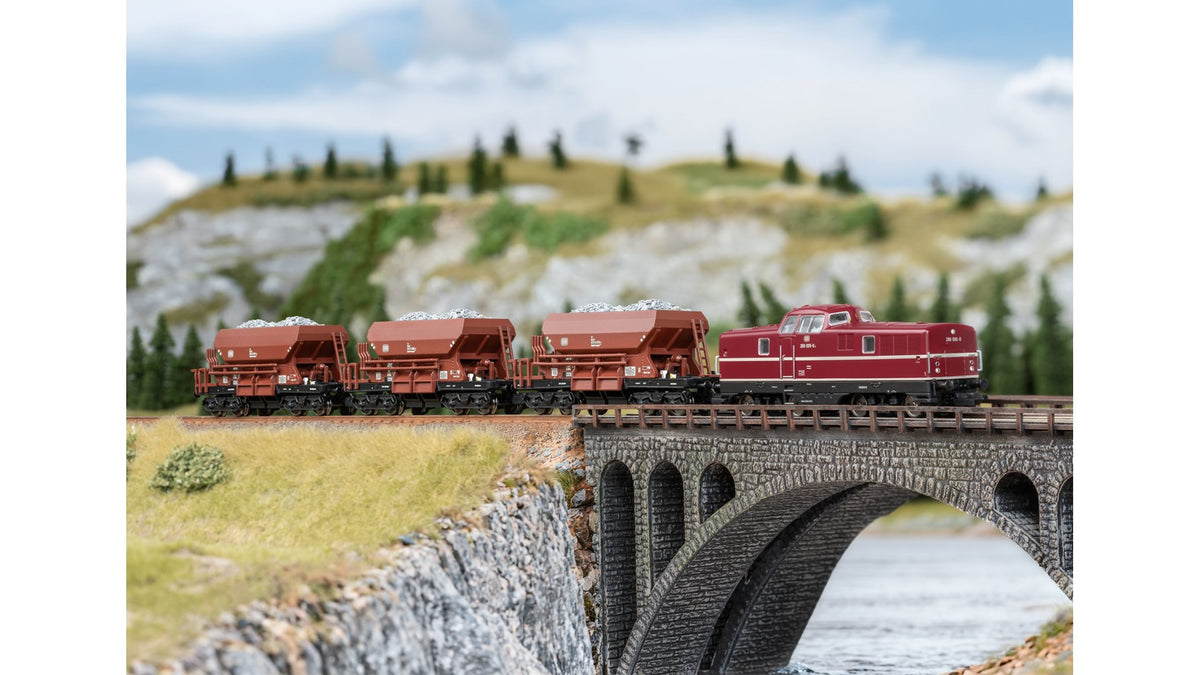
Minitrix T16802 Class 280 Diesel Locomotive
Model: The loco has a built-in digital decoder and sound generator for operation with mfx and DCC. The model has 4 axles powered; traction tires are fitted. The headlights and marker lights change over with the direction of travel. Warm-white LEDs are used for the lighting. The locomotive has a close coupler mechanism. The headlight changes over with the direction of travel in analog operation. Length over buffers 80 mm / 3-1/8".
Spare parts for our articles can be found here in our spare parts search.
One-time series.
88803 – German Federal Railroad (DB) class V 80 diesel locomotive
Before the Second World War, the construction of main-line diesel locos in Germany had not progressed beyond one-off designs, with power transmission proving to be the chief problem. The German State Railroad Company (DRG) had previously successfully tested the hydraulic torque converter developed by Föttinger in drive systems for diesel-powered rail cars. The class V 140 001 loco, built in 1935, marked the first successful application of hydraulic power transmission in a large diesel locomotive. The Second World War interrupted these pioneering experiments, but at the end of the 1940s, the newly established German Federal Railroad took a renewed interest in more powerful diesel locos and progressed their development quickly. The plan was to develop a general-purpose machine with two trucks suitable for medium-duty main lines and heavy switching duties. A maximum axle load of 15 metric tons (16.5 short tons) would also enable the loco to operate on branch lines. Power from the engine was to be transmitted via a hydraulic torque converter and cardan shafts to the reversing and wheel-set gear units.
The concept of the V 80, a twin-truck diesel loco with a high-mounted engineer’s cab in the center, was the result of a joint development involving the Bundesbahn Central Office in Munich and the railroad industry. The complete heating system was housed under the shorter nose section, while the cooling system and fuel tank were installed under the longer nose section. The transmission was installed centrally in the loco, below the cab. The trucks, frame, and body were fully welded. Initially, the available engines included two 800-horsepower units from Daimler-Benz and from MAN, respectively, as well as a 1,000-horsepower engine from Maybach. Maffei and MaK each delivered five class V 80 locos in 1951/52. They underwent extensive testing as innovative trailblazers for a new loco generation, and, naturally, they also required various improvements. Important modifications were the replacement of the original heating boiler with a vapor-heating unit and the replacement of the original engines with the MTU type MB 12V 493 with an output of 1,100 horsepower.
Following unsatisfactory trials for switching duties, the locos were used to operate commuter services in the greater Frankfurt and Nuremberg areas, often even with push-pull trains. Experience gained during operation soon showed that the class V 80 was not suitable for use as a general-purpose loco. It had insufficient power for main-line passenger services and was too cumbersome and expensive for use as a switcher. From the fall of 1963 onwards, all class V 80s were based at the Bamberg depot, where they were used on virtually all services in the region’s main and branch lines. Designated from 1968 onwards as the class 280 in line with the computerized numbering system, the locos were withdrawn from service as a small class between 1976 and 1978. Road number 280 010 was transferred to the Hersfeld County Railroad in 1977. Later on, it followed the remaining machines, except for road number 280 002, to Italy, where they found a new lease of life on private railroads and hauling construction trains. Road number V 80 002 was initially preserved as a DB museum loco, but it was so badly damaged by the fire at the museum's depot in Nuremberg-Gostenhof on October 17, 2005, that what remained of it had to be scrapped. In any event, road number V 80 001 returned from Italy in October 2005 after being purchased by a collector and has since been completely overhauled and restored both technically and visually in the style of the German Federal Railroad during the 1970s. In June 2008, the DB Museum was able to acquire road number V 80 005 as a replacement for road number V 80 002. The Meiningen Steam Locomotive Works then restored road number 280 005 externally with its original paint scheme by April 2013. This round of preservation work was completed in August 2013 by road number V 80 007, which was bought back from Ludger Guttweins Deutscher Privatbahn GmbH and now gleams once again visually as a gem in DB red.









Highlights:
- Digital sound with many functions.
Prototype: German Federal Railroad (DB) class 280 diesel locomotive, road number 280 005-0, with diesel-hydraulic drive and cardan-shaft power transmission; B-B wheel arrangement. The loco car looks as it did around 1976. It was used to haul light passenger and freight trains.
Digital Functions:
| DCC | SX2 | SX | MFX | |
| Headlight(s) | • | • | ||
| Horn | • | • | ||
| Diesel locomotive op. sounds | • | • | ||
| Headlight(s) | • | • | ||
| Direct control | • | • | ||
| Sound of squealing brakes off | • | • | ||
| Rear Headlights off | • | • | ||
| Bell | • | • | ||
| Front Headlights off | • | • | ||
| Station Announcements | • | • | ||
| Conductor's Whistle | • | • | ||
| Brake Compressor | • | • | ||
| Blower motors | • | • | ||
| Letting off Air | • | • | ||
| Doors Closing | • | • | ||
| Special sound function | • | • | ||
| Dialog | • | • | ||
| Whistle for switching maneuver | • | • | ||
| Heating equipment | • | • | ||
| Replenishing fuel | • | • | ||
| SIFA warning sound | • | • | ||
| Station Announcements | • | • | ||
| Station Announcements | • | • | ||
| Dialog | • | • | ||
| Sanding | • | • |
Specifications:
- Length over the buffers approximately 8.00 cm
- Scale: N (1:160)
- Type: Diesel Locomotives
Warning
|
ATTENTION: not suitable for children under 15 years. This product contains small parts that may be a choking hazard. |